Notary Public in and for Burgas Regional Court, registered under No. 246 at the Notary Chamber.
Why choose us
Free customer parking (2 spaces)
Parking in front of the office is easy. The office offers two dedicated customer parking spaces, so you can park at the door and get straight to your business.
An assistant notary — always available
Even while the notary is handling lengthy procedures (e.g. complex real-property transactions), there is always someone available for short, time-critical services — motor-vehicle ownership transfers, signature certifications, certified copies. No waiting for the next free slot.
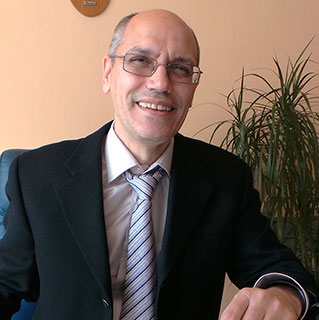
Notary Nikolai Nikov
Nikolai Nikov is a Notary in and for Burgas Regional Court.He was born in Burgas and graduated in Law from the Faculty of Law of Sofia University St. Kliment Ohridski in 1989.
From 1990 to 1998 he worked as a lawyer at the Burgas Bar Association, specializing in civil law.
In 1998 he started his practice as a Notary.
He is registered at the Notary Chamber of the Republic of Bulgaria under No. 246.
Services
- Certification of signatures, dates and contents of documents submitted to the Notary by the parties (such as powers of attorney, declarations, contracts, etc.);
- Certification of the authenticity of copies of documents (such as copies of diplomas, birth certificates, etc.);
- Drafting and execution (certification) of notary deeds for various real property transactions (sales, gifts, barters, transfers in exchange for a promise of lifetime personal care, establishment of the right to build, establishment of a contractual/legal mortgage, etc.);
- Drafting of statements of findings on the appearance and/or failure to appear in person before the Notary for the purposes of undertaking certain actions;
- Serving notarial invitations;
- All other types of certification as stipulated by law;
- Preparation and review of draft documents pertaining to the notary practice (preparation of draft notary deeds, contracts, powers of attorney, declarations, notarized wills, etc.);
- Oral and written consultations;
- Mediation for the purposes of clarifying the intentions of the parties;
- Verifications and enquiries;
- Obtaining documents, papers, etc. pertaining to the notary practice.
Important information
Dear customers, for any enquiries and consultations, or to make an appointment with the Notary in connection with his practice, please contact us by calling any of the following
telephone numbers (+359 56) 813 758; (+359 56) 823 040; (+359) 878 823 040; (+359) 879 803 043.
The working hours of our notary office are:
Monday to Friday 8:30 a.m. to 4:30 p.m., no lunch break.
For notary certifications outside our office, please contact us by calling (+359) 878 823 040.
The person whose signature needs to be certified has to appear in person before the Notary and present a valid identity document. If the person whose signature needs to be certified is represented by a duly authorized representative, such representative has to appear in person before the Notary and present a valid identity document, as well as the original notarized power of attorney. All documents presented to the Notary should be originals and should be in full force and effect. Normally, powers of attorney state their period of validity. If no period is stated, the power of attorney is considered valid indefinitely, and a power of attorney given for a specific action remains valid until that action has been completed.
Frequently asked questions
This section contains some of the most frequently asked questions in the notary practice.
Why does a spouse need to participate in the sale of a motor vehicle or real property?
When transferring the right of ownership of a motor vehicle or real property,
both the buyer and the seller have to appear before the Notary either in person or through an
authorized representative presenting a duly notarized power of attorney and declarations.
If the seller is married and the motor vehicle or real property subject to transfer was acquired
during the marriage, then the spouse has to participate, even if his/her name is not included in the
title (document certifying the ownership), because the Family Code stipulates that all property and
property rights acquired by the spouses during their marriage as a result of joint contribution belong
to both of them regardless of whose name they were registered in. Exceptions: Property and property rights
acquired before the marriage, as well as property and property rights acquired during the marriage in the
form of inheritance or gift, belong to the spouse who acquired them – in this case he/she can handle and
dispose of them at his/her own discretion.
What documents need to be presented to transfer a motor vehicle?
Normally, the documents that have to be presented to the Notary are the following: Motor Vehicle Registration Certificate – Part I; ID cards /passports/ of the people participating in the transaction /sellers, buyers, authorized representatives, etc./; Receipt for payment of the motor vehicle tax; if the transferred property is inherited, a valid certificate of inheritors must also be presented.
What documents need to be presented to transfer real property?
Normally, the documents that have to be presented to the Notary are the following: Notary Deed or another valid title document; cadastral drawings /blueprints/ if the real property is included in a cadastral map and filed in the cadastral registries; Tax Valuation Certificate for the real property; ID cards /passports/ of the people participating in the transaction /sellers, buyers, authorized representatives, etc./; if the transferred property is inherited, a valid certificate of inheritors must also be presented.
Can a cellar or attic be sold separately from the independent housing unit to which it belongs?
Cellars and attics are considered parts of the housing unit to which they belong from the moment when a building is designed. They are service /accessory/ facilities which exist to complement the use of the ‘principal’ property, i.e. the housing unit. As an accessory and integral part of a given housing unit, the cellar or attic may be sold, given as a gift or bartered, but only to a person who owns an independent unit – a housing unit – in the same building, in other words, a person cannot own only a service unit /cellar or attic/ in a building without actually owning an independent unit – a housing unit in the same building. Moreover, after the sale of the accessory unit pertaining to the housing unit, there must always be another accessory unit left (for example, if you sell your cellar, you must be left with an attic). Sometimes the purpose of the accessory units may be changed under certain conditions provided for by law, and subject to an approved architectural design and the consent of the other owners. In such cases, these units become independent units and they may be disposed of by their owners in the same way as any other independent unit.
Is a power of attorney signed and notarized abroad valid in Bulgaria?
A power of attorney, as well as all other documents which are not subject to filing with the Registry Agency, may be certified abroad and be valid in the territory of the Republic of Bulgaria, as long as some requirements are met.
Variant I: The power of attorney has to be certified by the Consular Office at the Embassy of the Republic of Bulgaria in the respective country. In this case, some requirements of the Bulgarian legislation have to be met, such as the requirement for notarization of specific declarations together with the notarization of the power of attorney in duplicate when granting a power of attorney for handling and disposal of real property; furthermore, the person has to place his/her signature and write down his/her full name as appearing in his/her identity documents; and finally, the notarization of the power of attorney has to certify both the signature of the person and the contents of the document.
Variant II: The power of attorney has to be notarized by a local Notary or a person functioning as a notary, and in this case the certification is made in compliance with the legislation of the respective country /if it is a power of attorney for handling and disposal of real property, once again the power of attorney will have to be notarized together with the declaration forms which pertain to it, but the Notary will be the one to decide if the person needs to write down his/her full name in the document, and if both the signature and the content of the power of attorney need to be notarized; normally, only the signature of the authorizing person is notarized/. Three hypotheses exist in this case:
- If the issuing and receiving countries are parties to Hague Convention No. 12 cancelling the requirement for authentication (legalization), the power of attorney (the document/instrument) has to be notarized by a local Notary, and then an Apostille has to be placed. The Apostille is a stamp which is placed by the authorized body of the respective country /Ministry of Justice, Consular Office of the Ministry of Foreign Affairs, Court of Law, Municipality, Police Department or another body/. A document notarized and certified with an Apostille in this way will not need any further certification either in the territory of the Republic of Bulgaria, or in the territories of any of the other members of the abovementioned convention; it will only need to be translated, and in some cases such translation may have to be certified by the Consular Office of the Ministry of Foreign Affairs.
- In the cases where an agreement for legal aid has been signed between the Republic of Bulgaria and the country where the power of attorney was notarized, such agreement may provide for the direct recognition of certain documents, or in other words the power of attorney may be recognized as an official document if notarized, without any need for certification with an Apostille.
- If the document is not certified with an Apostille or cannot be certified with an Apostille, or is notarized in a country with which Bulgaria has not signed an agreement for legal aid, in order to be recognized as an official document in Bulgaria, the document has to be authenticated in compliance with the existing requirements, or in other words to be certified by the Ministry of Foreign Affairs of the issuing country, and then to be authenticated by the Bulgarian Diplomatic or Consular Office in that country.
Is it possible to complete a real property transaction outside the office of the Notary or by a Notary acting in and for another regional court? How can this happen?
According to Article 573 of the Civil Procedure Code, Notaries cannot practice their profession outside the region in which they are registered. Notary deeds that are subject to registration are issued only in the office of the Notary during working hours. Other notary services /such as certification of signatures placed on powers of attorney, declarations, etc./ may be performed outside the office of the Notary and outside normal working hours, when, for valid reasons, the participating parties cannot appear in the office, or if it is crucial that the service be provided immediately.
When a transaction takes place, the parties have to appear in person before the Notary to sign the notary deed. A Notary with the required competence is the one who practices his/her profession in the region where the real property is located. Notaries cannot complete transactions in any other judiciary region.
The seller has to present to the Notary the original documents of the real property certifying the rights of ownership. The Notary then makes sure that the said real property is located in the region of his/her competence.
The Notary verifies the identity, capacity and representative powers of the parties who appear before him/her.
The Notary makes sure that no legal impediments exist that may preclude the transfer of the real property.
The Notary makes sure that the draft notary deed meets the legal requirements.
The Notary makes sure that the seller is the owner of the real property.
The Notary reads aloud to the parties the contents of the draft notary deed, and the parties confirm their intentions before the Notary, as indicated in the draft notary deed.
The notary deed is then signed by the parties and the Notary.
The Notary submits the notary deed to the Registry Agency in the region where the real property is located, and then the Registry Judge issues an order for the notary deed to be entered in the Land Registry of the Registry Agency, which guarantees the rights of the buyer in the event of any claims filed by third parties.
The Notary delivers a copy of the notary deed to the parties. The Notary keeps on file all notary cases subject to registration for 10 years, and then destroys them. The book of all notary deeds issued by the Notary is kept for 100 years.
Is it mandatory to obtain a notary deed (title) for real property I inherited after the death of its former owner?
If you have inherited real property, you can identify yourself as the owner of such real property by presenting the notary deed (title) held by the person from whom you inherited the property, and a certificate of inheritors proving that you are his/her heir/heiress. It is also possible to obtain a special notary deed of findings pursuant to Article 587, paragraph 1 of the Civil Procedure Code, but please note that such a notary deed of findings does not establish a new legal fact, i.e. you were the owner even before it was issued.
Contact
8000 Burgas, Bulgaria
57 Trayko Kitanchev Str.
Working hours:
Monday to Friday, 8:30 a.m. to 4:30 p.m., no lunch break